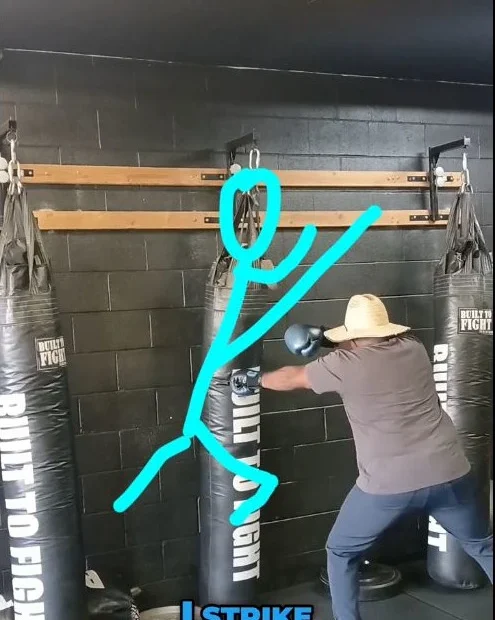
The purpose of this exercise is simple and foundational: learn how to block an opponent’s attack, recognize the opening that follows, and strike the flank with control and intent. Speed is not the goal at the beginning. Timing, structure, and correct positioning come first. Speed will come naturally with practice.
This drill is modeled after concepts found in Eagle Claw Lian Quan, particularly Forms 2 and 4, where defensive structure and immediate counterattacks are trained together. Rather than treating blocking and striking as separate actions, this approach trains them as a single continuous idea.
The Core Concept: Defense Creates the Opening
A common mistake in training is to think of blocking as a “pause” in the exchange. In Eagle Claw methodology, a block is not the end of an action. It is the moment that creates opportunity.
When an opponent commits to an attack, their structure briefly opens somewhere else. Very often, that opening appears along the flank. The cross block is used to protect the centerline and head while placing the body in a position to recognize and exploit that opening.
This drill reinforces three key ideas:
- Protect yourself first
- Read the opening created by the opponent’s attack
- Strike without hesitation, then recover your structure
The Cross Block in This Drill
The cross block is used as a compact, high-percentage defensive structure. The forearms form a crossed frame that shields the upper line while maintaining balance and alignment.
Key points to keep in mind:
- Cross block moves in 4 directions – up, down, left, and right
- Elbows are not flared wide
- The spine remains upright and supported by the stance
The goal is not to chase the opponent’s strike with your hands, but to occupy space and absorb or redirect the line of attack safely.
Striking the Flank
Once the block is established, attention immediately shifts to the opponent’s flank. Because the opponent has committed forward energy into the attack, one side of their body is often less protected.
The strike should be:
- Direct and efficient
- Delivered from a stable base
- Followed by an immediate return to guard or structure
This mirrors how Lian Quan Forms 2 and 4 emphasize continuous flow: defend, counter, and recover without overextending or freezing in place.
How to Train the Drill
This drill can be practiced on a heavy bag or with light partner work.
Basic structure:
- Assume a stable fighting stance
- Visualize an incoming attack
- Execute the cross block to protect the centerline
- Strike into the exposed flank
- Re-establish your guard or cross block
- Repeat with control
At first, move deliberately. Focus on clean mechanics and correct positioning rather than speed or power.
Why Speed Is Not the Priority
Speed without structure leads to bad habits. In this exercise, the priority is:
- Seeing the attack
- Blocking correctly
- Recognizing the opening
- Striking with balance
As these elements become consistent, speed will naturally increase. This is the same progression found in traditional Eagle Claw training: slow, correct repetitions first, followed by refinement and acceleration over time.
Common Training Errors to Avoid
- Rushing the strike before the block is complete
- Over-rotating or leaning into the counter
- Dropping the guard after striking
- Treating the drill as a power exercise instead of a timing exercise
Each repetition should reinforce calm control rather than urgency.
Not About Aesthetics But Effective
This cross block drill is not about flashy movement or brute force. It is about learning how to stay safe under pressure, recognize opportunity, and respond efficiently. Rooted in Eagle Claw Lian Quan Forms 2 and 4, the exercise develops timing, awareness, and discipline that carry over into sparring, forms practice, and self-defense scenarios.
Train it patiently. Let the block teach you when to strike.