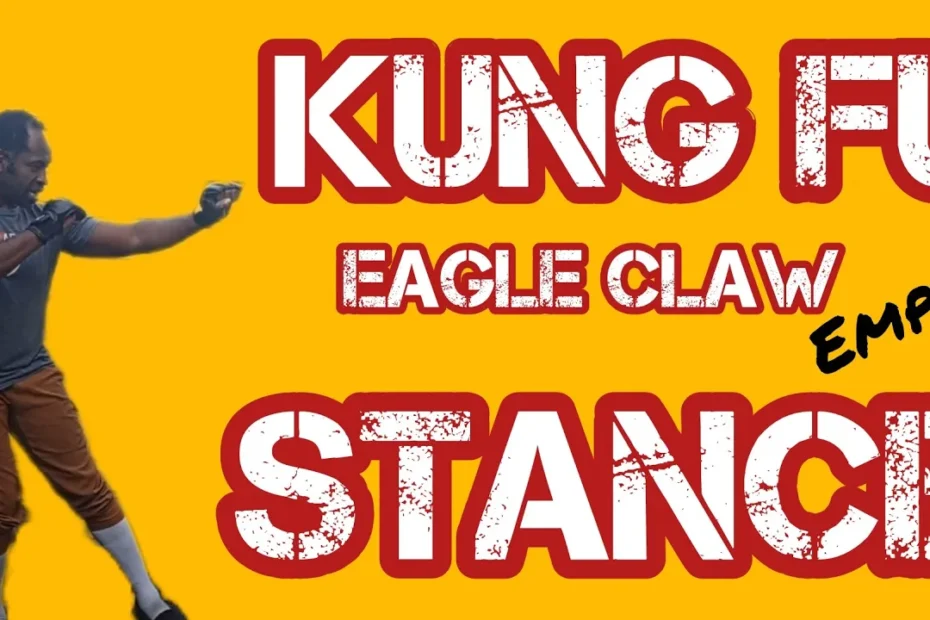
In this second lesson on the Eagle Claw empty stance, the focus shifts toward refining your technique. The goal is not just to understand the stance intellectually, but to improve how you move, balance, and apply it so it becomes natural in your training.
As you go through the lesson, pay attention to the many uses of the stance. From building leg strength to improving balance, stepping, and developing a natural guard, the empty stance becomes a foundation that you can incorporate into your own way of training and moving.
Modern martial arts training allows you to learn and refine your practice from anywhere. By observing with an open mind and practicing intentionally, you can improve your stance even when training on your own.
Keep Your Back Straight and Your Posture Stable
One of the most important technical details to focus on is posture.
As you practice the empty stance, imagine that you are slowly sitting down into a chair. This simple mental image helps you sink your weight properly without leaning forward.
While training, focus on the following details:
- Keep your back straight
- Allow your hips to settle naturally
- Keep your shoulders relaxed
Practicing in front of a mirror can be extremely helpful. Watching your posture allows you to catch mistakes early and maintain proper alignment.
Focus on Proper Weight Distribution
The empty stance requires most of your body weight to be placed on the back leg.
Your front leg should remain light and mobile so you can move or kick quickly. During practice, check that you are not placing too much weight on the front foot.
The front foot should also be slightly angled outward. This position allows smoother transitions when stepping, striking, or kicking.
Some practitioners rotate the hip more during the step, while others keep the foot slightly angled. Try both approaches during practice and see which one allows you to move more comfortably and efficiently.
Learn to Relax and Ground Your Energy
Another important aspect of the stance is grounding.
In traditional Chinese martial arts, this concept is often described as allowing your energy to sink downward. In practical terms, this means staying relaxed and balanced while maintaining strong structure.
As you practice the stance, avoid unnecessary tension. Focus on staying rooted while allowing your body to move naturally.
Many of these ideas are also found in Tai Chi training, where relaxation and structure work together to create stability and power.
Explore Grappling and Close-Range Applications
The empty stance is not limited to striking techniques.
As you become more comfortable with the stance, experiment with transitions into grappling movements. The stance can naturally lead into sweeps, hooks, and takedown entries.
You can explore movements such as:
- Overhooks
- Underhooks
- Wrestling-style entries
This type of practice helps you understand how the stance can function during close-range combat situations.
Maintain a Strong Guard While Striking
When practicing strikes from the empty stance, pay close attention to your hand positioning.
Your lead fist should remain roughly around shoulder height, while the lower fist should stay near the elbow of the opposite arm. This structure protects your body while keeping your hands ready to strike.
Each time you throw a strike, return the hand quickly to its guard position. Good guard discipline allows you to stay protected while remaining ready for the next movement.
Train Both Sides of the Stance
To become well-rounded, you must train the stance on both sides of your body.
Spend equal time practicing with your left side forward and your right side forward. Balanced training prevents you from becoming dependent on only one side.
Over time, both sides should feel equally comfortable and natural.
Blend Concepts From Other Martial Arts
As you continue training, remember that martial arts are not always confined to one system.
The empty stance can work alongside principles from other disciplines such as Tai Chi, wrestling, or Brazilian Jiu-Jitsu. Understanding how different systems interact can make your training more adaptable and effective.
Focus on learning the structure first, then explore how the stance can transition into other movements and techniques.
Practice a Simple Strength and Balance Drill
One effective drill for developing strength in the empty stance is repeatedly switching legs while maintaining proper posture.
Move slowly and focus on keeping your back straight as your weight shifts from one leg to the other.
During the drill, concentrate on:
- Controlled weight transfer
- Maintaining balance
- Keeping your posture upright
Practicing this exercise regularly will strengthen the supporting leg and improve your ability to maintain the stance while moving.